


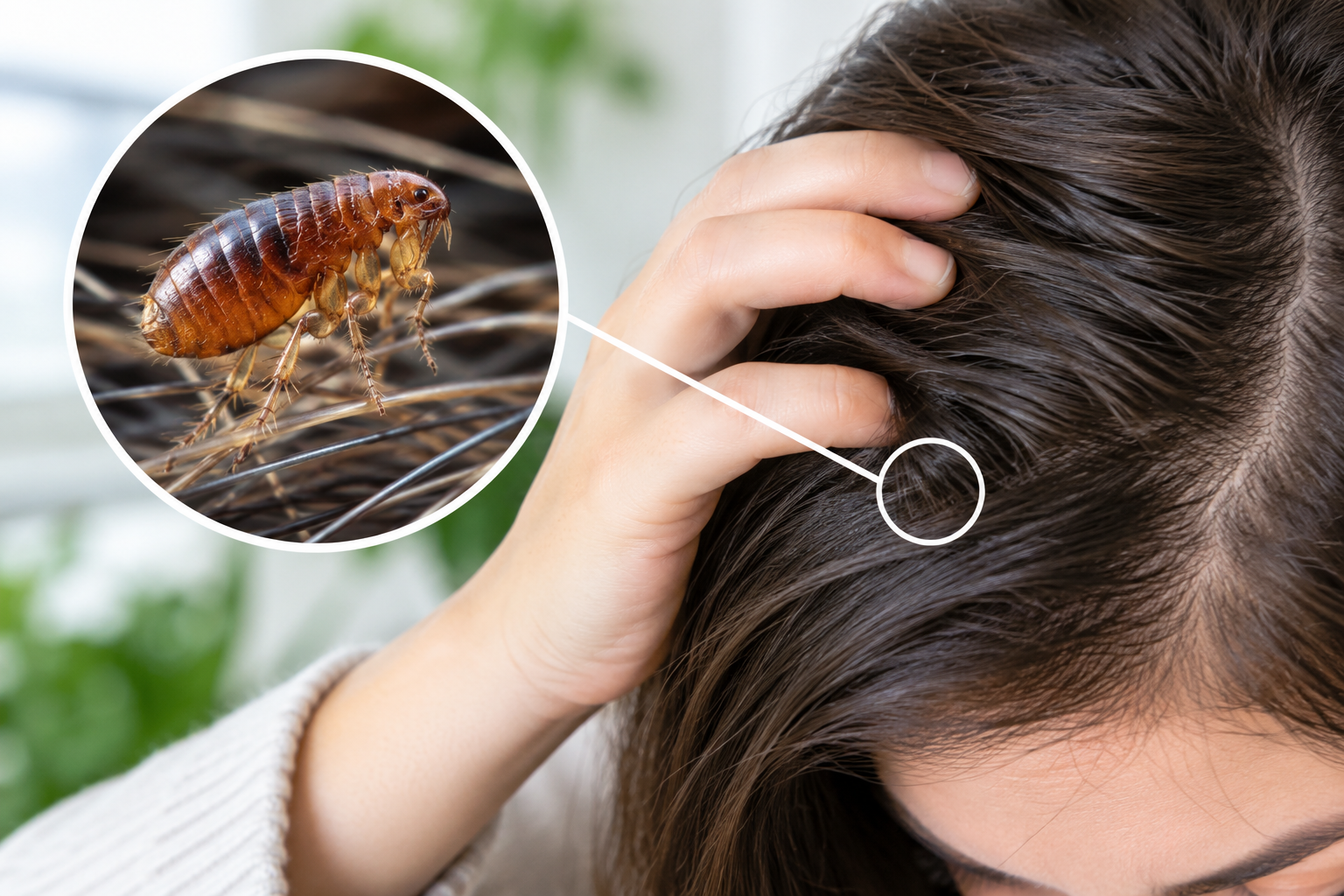
Finding a tiny, fast moving bug in the hair is enough to make anyone panic, especially with a pet at home that’s been scratching more than usual lately. The good news is that the panic is usually bigger than the actual problem. Fleas can absolutely end up in human hair for a moment, but that’s a very different thing from actually living there.
The Short Answer
No, fleas do not live in human hair long term. A flea might jump onto a person briefly, bite, and move on, but human hair doesn’t offer what a flea actually needs to settle in and reproduce. If fleas are showing up in someone’s hair repeatedly, it’s a strong sign of a bigger flea problem somewhere else in the home, usually involving a pet.
Why Human Hair Doesn’t Work for Fleas
Fleas evolved specifically to live in dense fur, and human hair falls short on almost every requirement that makes fur a viable home.
Not Dense Enough
A dog or cat’s coat is thick enough to hide fleas, their eggs, and their waste product, sometimes called flea dirt, deep against the skin. Human hair, even when long, is far more sparse by comparison, which leaves fleas with nowhere to hide and nothing to grip onto for long.
Wrong Temperature
Fleas are drawn to the higher body temperature of most household pets, generally around 101 degrees Fahrenheit, compared to an average human scalp temperature closer to 91 degrees. That difference alone makes a human head a less appealing environment for a flea looking to settle in.
No Buildup of Flea Dirt
Flea larvae depend on flea dirt, the digested blood waste left behind by adult fleas, as their primary food source. That buildup happens in pet fur and in carpet fibers, not in human hair, which gets washed and brushed far more frequently than an animal’s coat.
Grooming Habits Get in the Way
Regular washing and brushing knocks fleas loose before they have much chance to settle in. Combined with the lack of flea dirt and the wrong temperature, this makes it extremely difficult for a flea population to establish itself on a human head, even with repeated exposure.
Fleas vs. Lice: Why They Get Confused
A lot of the anxiety around fleas in hair actually stems from confusing them with head lice, which are a completely different insect built specifically to live on humans. Here’s how the two compare.
| Feature | Fleas | Lice |
| Movement | Jump between hosts and surfaces | Crawl only, cannot jump |
| Preferred host | Dogs, cats, and other furry animals | Humans specifically, host specific to people |
| Where eggs are laid | Carpet, bedding, cracks, and animal fur | Glued directly to individual hair strands |
| Body shape | Flattened side to side for moving through fur | Elongated with claws built for gripping hair |
| Typical human contact | Brief, usually bites and moves on | Sustained, lives on the scalp continuously |
The biggest giveaway is movement. A flea in hair moves fast and jumps, often disappearing the moment it’s spotted. Lice crawl slowly and stay put, which is part of why they’re able to live on a human scalp continuously in a way fleas simply can’t.
What About Human Fleas?
There is a species called the human flea, or Pulex irritans, which historically fed on humans more than most other flea species. Even this species doesn’t live in human hair the way lice do. It behaves like other fleas, biting and moving on rather than settling permanently on a host’s head, and it has become uncommon across much of the developed world as living conditions and hygiene standards changed.
Signs a Flea Ended Up in Someone’s Hair
- A small, dark, fast moving insect that jumps rather than crawls.
- Itchy, red bites, often in clusters, particularly around the neck, ears, or hairline.
- Recent contact with a pet that has fleas, or time spent in an area with a known infestation, like a yard or a friend’s home with pets.
- No consistent presence day after day, unlike lice, which stick around and multiply on the scalp itself.
What to Do If a Flea Ends Up in Someone’s Hair
- Wash the hair thoroughly with regular shampoo, which is generally enough to remove a flea that jumped on briefly.
- Comb through wet hair with a fine tooth comb to check for and remove any remaining insects.
- Check pets for fleas, since a flea in someone’s hair is almost always a sign of an active infestation on an animal in the home.
- Treat the home and any affected pets directly, since the hair itself was never really the source of the problem to begin with.
When It’s Worth Calling a Professional
A flea or two showing up occasionally usually points to an active pet infestation that needs direct treatment, not a hair specific problem. If fleas keep appearing despite treating pets and washing bedding, or if a home has a larger, established infestation in carpets and furniture, professional pest control is typically the more reliable path forward than repeated DIY treatments.
Final Thoughts
Fleas can technically end up in human hair for a short time, but they’re not built to live there, and there’s no need to treat hair itself as the source of a flea problem. If fleas keep showing up, the real fix is treating the pet and the home directly, since that’s almost always where the actual infestation is living.
Frequently Asked Questions
Can fleas lay eggs in human hair?
Not in any meaningful way. Human hair lacks the density and warmth fleas need for eggs to develop, and flea eggs also aren’t glued to hair strands the way lice eggs are, so they tend to fall away rather than remain in place.
How long can a flea survive in human hair?
A flea might remain briefly, generally no more than a day or two at most, before falling off, being washed out, or moving to a more suitable host like a pet.
Is it possible to get an infestation of fleas in human hair like lice?
No. Fleas are not adapted to live continuously on human hair the way lice are, so a true flea infestation confined to human hair does not occur.
How can someone tell the difference between fleas and lice in their hair?
Fleas are dark, flattened, and jump quickly, while lice are slower moving, crawl rather than jump, and are typically found along with tiny eggs glued directly to individual hair strands.
If fleas are found in hair, does that mean there’s an infestation at home?
Usually, yes. Fleas showing up in hair almost always trace back to an infested pet or an infestation somewhere in the home, such as carpets, furniture, or pet bedding.
Can fleas bite the scalp?
Yes. Fleas can bite any exposed skin, including the scalp, though they typically don’t stay in place afterward the way lice would.