


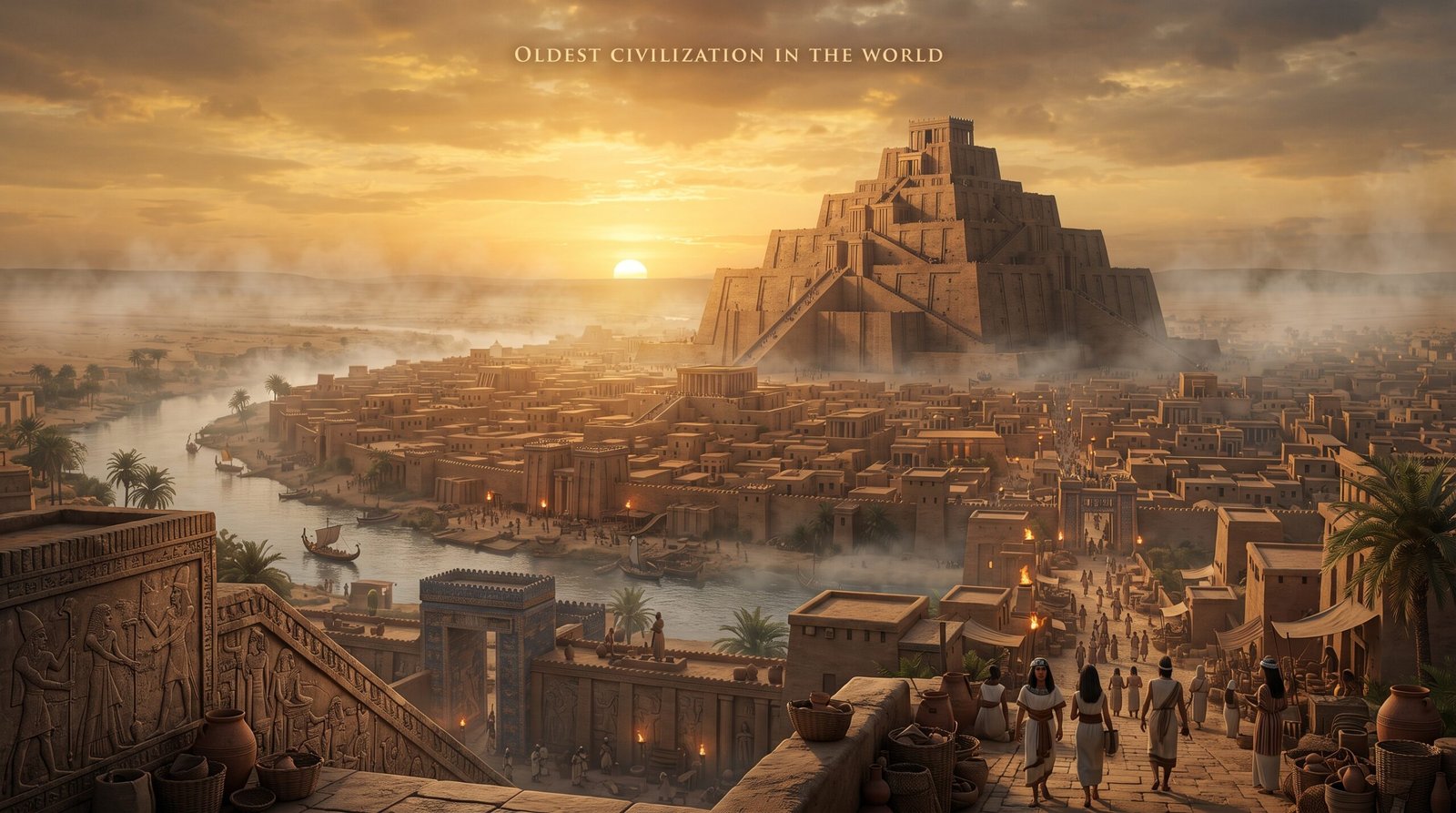
Ask a historian which civilization came first, and the answer usually arrives with a caveat attached. It depends entirely on what counts as a civilization in the first place. Define it as organized cities, writing, and government, and one answer emerges clearly. Define it more loosely, as sustained human culture and connection to land, and the timeline stretches back tens of thousands of years further, to peoples who never built cities at all.
This article covers both sides of that answer: the civilization most historians point to as the oldest by the conventional definition, and the older cultures that complicate a simple answer to the question.
What Counts as a Civilization
Historians generally define a civilization by a cluster of features appearing together: permanent cities, a system of writing, organized government, social hierarchy, and specialized labor, like dedicated farmers, priests, and craftspeople rather than everyone doing a bit of everything. By that definition, scattered villages or seasonal settlements don’t count, even if they’re genuinely old. The bar is organized, urban, recorded society, not just the presence of humans living somewhere.
Sumer: The Civilization Most Historians Point To
By the standard definition above, ancient Sumer in southern Mesopotamia is the answer most historians give. Sumerian cities like Uruk and Ur emerged in the region between the Tigris and Euphrates rivers, in what’s now southern Iraq, somewhere around 4500 to 4000 BCE, with urban civilization firmly established by roughly 3500 BCE.
What Made Sumer Stand Out
- Cuneiform, one of the earliest known writing systems, developed initially for trade and record keeping.
- Some of the world’s first true cities, including Uruk, which may have held tens of thousands of residents at its height.
- Early codified law, including the Code of Ur-Nammu, which predates the better known Code of Hammurabi by centuries.
- Advances in mathematics and astronomy, including a base sixty numbering system that still shapes how time and angles are measured today.
- Organized irrigation systems that supported large scale agriculture in an otherwise dry region.
Other Early Civilizations Worth Knowing
Sumer wasn’t alone for long. Several other civilizations emerged independently within a few centuries to a couple of millennia afterward, often without direct contact with Mesopotamia.
| Civilization | Approximate Start | Location |
| Sumer (Mesopotamia) | Around 4500 to 4000 BCE | Southern Iraq, between the Tigris and Euphrates |
| Ancient Egypt | Around 3100 BCE | Nile Valley, Egypt |
| Indus Valley Civilization | Around 3300 BCE | Modern day Pakistan and northwest India |
| Norte Chico (Caral) | Around 3500 BCE | Coastal Peru, South America |
| Ancient China (Yellow River) | Around 2070 BCE | Yellow River Valley, China |
| Minoan Civilization | Around 3000 BCE | Crete, Greece |
What’s notable here is that several of these civilizations developed cities, writing, or organized agriculture independently of one another, within a relatively narrow window of human history, rather than one culture simply spreading its ideas to the rest of the world.
Why the Question Gets More Complicated
The idea of a single oldest civilization gets harder to defend once older human history enters the picture, even outside the strict definition of civilization used above.
Göbekli Tepe
In what’s now southeastern Turkey, archaeologists uncovered monumental stone structures at Göbekli Tepe dating back roughly 11,000 to 12,000 years, predating Sumer by thousands of years. It was built by hunter gatherers, not an urban, literate society, so it doesn’t meet the standard definition of a civilization, but it does show that large scale, organized construction happened well before cities or writing existed.
Aboriginal Australian Culture
Aboriginal Australians represent one of the longest continuous cultures in human history, with evidence of habitation in Australia stretching back at least 50,000 years. This culture didn’t develop cities or writing in the way the standard definition requires, which is why it isn’t typically labeled a civilization in historical classifications, but its sheer continuity dwarfs the timeline of any society on the list above. It’s a useful reminder that “civilization” is a specific technical term, not a measure of a culture’s age, complexity, or value.
Why Mesopotamia Still Gets the Credit
Modern scholarship has moved away from treating Mesopotamia as a single, isolated “cradle of civilization” and now recognizes it as part of a broader, multi centered network of early complex societies across the ancient Near East. Even so, Sumer tends to retain the “first” title specifically because of how early and how clearly it checked every box: cities, writing, government, and social specialization, all appearing together and well documented through surviving written records.
Final Thoughts
The honest answer to “what is the oldest civilization in the world” is that it depends on the definition being used. By the standard historical criteria, cities, writing, and organized government, Sumer in ancient Mesopotamia holds that title, with civilizations in Egypt, the Indus Valley, and coastal Peru following not far behind. Step outside that definition, and the story of human culture stretches back tens of thousands of years further, long before anyone built a city or wrote anything down.
Frequently Asked Questions
What is officially considered the oldest civilization in the world?
Sumer, located in ancient Mesopotamia in what’s now southern Iraq, is generally considered the oldest civilization by historians, with urban centers emerging around 4000 BCE.
Was Egypt older than Mesopotamia?
No. Ancient Egyptian civilization is generally dated to around 3100 BCE, several centuries after Sumerian cities had already developed in Mesopotamia.
Is Göbekli Tepe older than Sumer?
Yes, by a wide margin. Göbekli Tepe dates back roughly 11,000 to 12,000 years, but it was built by hunter gatherer groups rather than an urban, literate society, so it isn’t classified as a civilization under the standard historical definition.
Why isn’t Aboriginal Australian culture called the oldest civilization?
Aboriginal Australian culture is one of the oldest continuous cultures in human history, with roots going back at least 50,000 years, but it didn’t develop cities or writing systems, which are the defining features historians use to classify a society as a civilization.
Did civilizations develop independently in different parts of the world?
Yes. Civilizations in Mesopotamia, Egypt, the Indus Valley, China, and coastal Peru all developed largely independently of one another, often without direct contact, within a few centuries to a couple of millennia of each other.
What features define a civilization historically?
Historians typically look for organized cities, a writing system, structured government, social hierarchy, and specialized labor roles as the defining features that separate a civilization from earlier village or tribal societies.


