
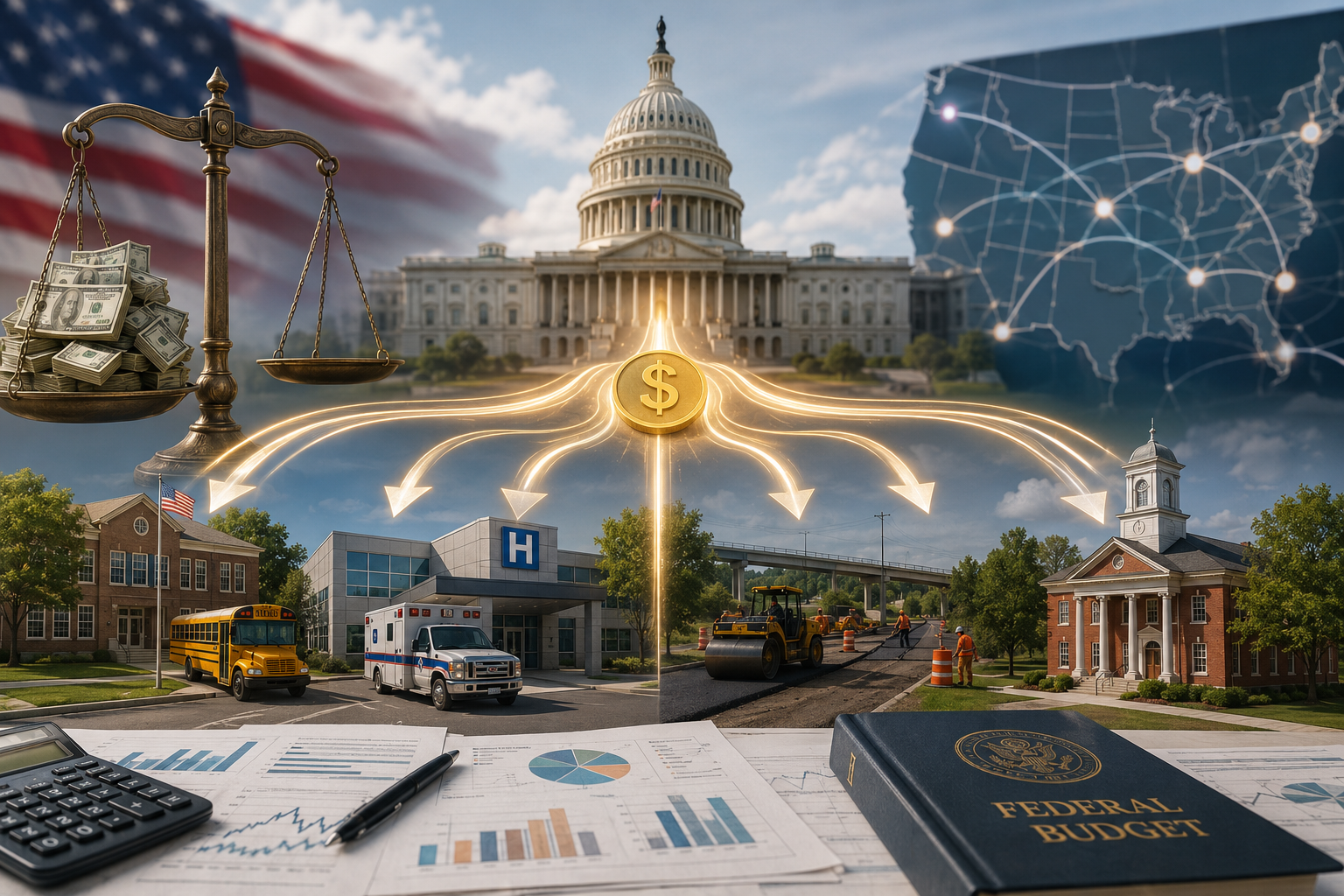
kind of the problem. It’s one of those concepts that works quietly in the background, shaping how government money moves from Washington all the way down to your local school district or county hospital. Once you understand what it actually does, you start seeing its fingerprints everywhere.
The Simple Version — What Is a National Finance Commission?
Here’s the plain truth: the federal government collects a massive amount of tax revenue every single year. But it’s your state government, your county, your city — those are the entities that actually go out and build the roads, staff the emergency rooms, and keep the lights on in public schools.
Someone has to decide how that money gets divided. That’s the core job of a National Finance Commission.
Revenue sharing is the process by which the federal government allocates collected revenue to state and local governments — ideally with enough flexibility so that local jurisdictions can address their own unique needs rather than following rigid, one-size-fits-all rules.
Without a clear structure overseeing this process, the whole thing can turn into a political tug-of-war. Bigger states lobby harder. Wealthier regions pull more influence. And the places that actually need the most support end up with the least. A National Finance Commission is supposed to prevent exactly that.
How the United States Handles This
The U.S. doesn’t have a single agency with the official title “National Finance Commission.” Instead, it splits this responsibility across several institutions — some old, some newer, some more effective than others.
The Senate Finance Committee — America’s Closest Equivalent
The Senate Finance Committee, which dates back to 1816, holds jurisdiction over taxation, Social Security, Medicare, Medicaid, national debt, revenue sharing, trade agreements, and unemployment insurance. That’s a remarkably broad mandate and in practice, this committee does a lot of the heavy lifting that a formal National Finance Commission would handle in other countries.
The GAO — The Watchdog Nobody Talks About Enough
The U.S. Government Accountability Office is another piece of this puzzle. Think of the GAO as the auditor that tells Congress when things are going sideways financially.
As of early 2025, the GAO released its annual fiscal health report warning that the federal government faces an unsustainable financial path as publicly held debt keeps rising. That kind of independent oversight is exactly what a well-functioning national finance body should be doing and the GAO does it without much fanfare.
The Money Problem Nobody Wants to Talk About
Here’s where things get uncomfortable. The United States is running serious deficits, and the way revenue gets distributed across federal, state, and local levels is under more strain than it’s been in decades.
In fiscal year 2025, the federal government spent $7.0 trillion covering everything from national defense to Medicare, Medicaid, infrastructure, and education but federal revenue only covered $5.2 trillion of that, leaving a deficit of roughly $1.8 trillion. Center on Budget and Policy Priorities
That gap doesn’t just disappear. It gets borrowed. And when the federal government is borrowing at that scale, every decision about where money flows — which states, which programs, which communities — becomes more consequential.
About 51 cents of every federal revenue dollar comes from individual income taxes, and in 2025, total federal revenue sat at roughly 17.3 percent of GDP, right at the historical average. Center on Budget and Policy Priorities
The revenue is there. The question is whether the system distributing it is fair, transparent, and actually built to serve people rather than political priorities.
What a National Finance Commission Is Supposed to Do — The Core Goals
Whether you’re talking about a formal commission in another country or trying to evaluate how well the U.S. patchwork system works, the goals should be the same.
Keeping Revenue Distribution Fair
The main job is making sure tax revenue collected at the central level gets shared with regional governments based on clear, agreed-upon formulas — so that states and localities can fund schools, healthcare, infrastructure, and everyday public services. FinancePilotPro
Fair doesn’t mean equal. A rural county with high poverty and limited local tax base genuinely needs a different level of federal support than a wealthy suburban district. A good commission accounts for that.
Closing the Gap Between Rich and Poor Regions
The U.S. is actually the only major democracy that lacks a consistent national-level system of fiscal equalization — even though many individual states do address local property tax disparities through their own equalization policies.
That’s a striking fact when you sit with it. Every other major democratic economy has figured out some structured way to make sure poorer regions don’t get left behind. The U.S. largely relies on congressional negotiations, grant programs, and appropriations battles instead — which is messier and more prone to political distortion.
Watching the Long-Term Numbers
A national finance oversight body should be evaluating government expenditures, scrutinizing debt trajectories, and proposing reforms before imbalances spiral into crises. St-aug
That’s not just bookkeeping — it’s the kind of forward-looking work that prevents the slow-moving fiscal disasters that governments tend to ignore until they can’t.
Real Challenges That Get in the Way
None of this is easy in practice. Even the best-designed finance commission runs into problems.
Common roadblocks include political pressure from powerful regions trying to gain an advantage, ongoing debates over which indicators are truly “fair,” outdated population or poverty data that distorts the formulas, and accountability gaps where funds don’t always get used effectively once distributed.
In the American context, you see this play out every budget season. States with more congressional seniority often secure better funding deals. Earmarks slip into appropriations bills. The system works — but not always in the way it’s supposed to.
Why This Conversation Matters Right Now
The U.S. is at a point where fiscal decisions made in Washington are having increasingly uneven effects across the country. Some states are flush with federal infrastructure dollars. Others are watching their public systems strain under decades of underfunding.
Finance analysts and governance experts broadly agree that structured revenue-sharing models improve long-term stability and reduce fiscal inequality — and that such systems matter most in countries with genuinely diverse economic conditions.
That description fits the United States perfectly. A country with Silicon Valley and Appalachia both within its borders needs a thoughtful, data-driven system for distributing national resources. Right now, that system is fragmented — and the conversation about improving it is long overdue.
For more on how federal dollars flow through the American system, the Center on Budget and Policy Priorities publishes clear, regularly updated breakdowns worth bookmarking.